

Canada Groceries and Essentials Benefit: Payments Explained
Quick answer
See how the former GST/HST credit changed in July 2026, who is considered automatically, payment dates, recalculations and missing-payment steps.
- Start with the official registration or attachment pathway.
- Confirm local eligibility, catchment and current intake directly.
- Keep a dated record and use appropriate temporary care while waiting.
Published: October 1, 2026 Last updated: October 1, 2026
Benefit handoff: the GST/HST credit became the Canada Groceries and Essentials Benefit in July 2026.
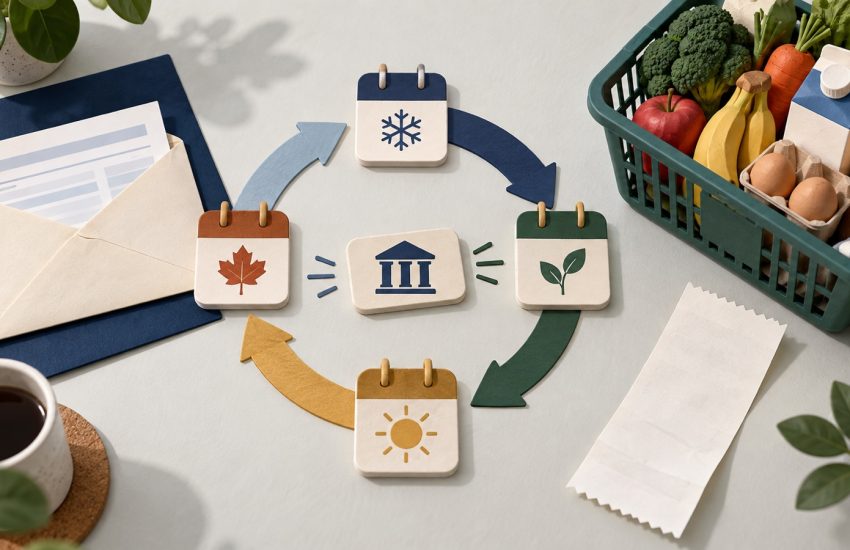
Read the benefit as a four-quarter clock
The Canada Revenue Agency says the Canada Groceries and Essentials Benefit, or CGEB, is a tax-free quarterly payment for eligible people and families with low or modest incomes. The name changed, but the payment still turns on tax filing, household information, CRA calculations and a quarterly schedule.
July
A new benefit year begins using the previous year’s tax information.
October
The next quarterly payment follows the CRA calendar.
January
A new calendar year does not by itself reset the benefit year.
April
File the next return so CRA can calculate the following July cycle.
The change arrived with a practical source of confusion. Someone searching an old notice may see “GST/HST credit.” A bank description or newer CRA page may say “Canada Groceries and Essentials Benefit.” A social post may shorten the name to “grocery benefit.” The safest way to reconcile them is to begin with the CRA’s current CGEB page and the notice in the recipient’s CRA account.
This guide explains the payment cycle, not an individual entitlement. CRA decides eligibility and amount from the law and information on file. Dollar figures and dates can change. Check the current official page before making a budget decision or sharing advice with someone else.
There is usually no separate application for a person who is already a Canadian resident and files a tax return. Filing triggers consideration. Some newcomers to Canada use a separate benefits application process before they have filed a return. Those are different routes; do not submit a newcomer form simply because a regular payment is late.
First handoff: from tax return to benefit year
CRA calculates the CGEB using income and family information from tax returns. For the July 2026 to June 2027 payment period, CRA’s guide says the calculation uses information from the 2025 return. Each spouse or common-law partner should file a return, even when one person had no income, so CRA has the household information it needs.
The July-to-June cycle matters. A return filed in spring supports the benefit period beginning in July. The amount does not normally change simply because January arrives. A later reassessment, household change, custody information, death, or a correction to CRA’s records can change the calculation during the cycle.
Do not confuse filing a return with receiving a particular amount. Filing lets CRA consider the household. Eligibility and payment depend on adjusted family net income and family circumstances. A person with no tax payable may still need to file to receive income-tested benefits.
If you have not filed the return used for the current period, that is the first missing handoff to examine. File accurately through an appropriate route, keep the assessment, and allow CRA to process it. Do not estimate a benefit from gross income alone; CRA’s calculation uses defined tax information.
What changed in July 2026
The official CGEB page says the benefit replaced the GST/HST credit beginning in July 2026. The CRA describes the new benefit as maintaining the same eligibility, calculation and quarterly payment structure, with enhanced amounts under the new program. For a current claim, use the CGEB page and current notices rather than relying on an archived GST/HST credit article.
A name change does not require most existing recipients to start over. If you filed the required return and CRA has current family information, CRA assesses eligibility automatically. The notice or account record explains the calculation. It is the better source for your amount than a calculator copied into an unofficial article.
CRA’s 2026–27 guide lists maximum annual amounts before the income-based reduction. It gives up to $679 for a single person, up to $890 for a married or common-law couple, and up to $234 for each child under 19. Those are maximums, not promises. Household income and circumstances affect the actual result.
Use those figures to understand the shape of the program, not to forecast a deposit without CRA information. A family may receive less, receive nothing, or have a payment applied to a debt under rules described by CRA. If your notice differs from your estimate, read the calculation details before assuming an error.
The clock has five gears
A delayed or different payment usually belongs to one gear. Start with the earliest one that is incomplete. A payment trace cannot fix an unprocessed return; a new return is not the answer when CRA already issued the payment to an old bank account.
Second handoff: understand the quarterly dates
CRA’s benefits payment calendar lists July 3 and October 5 for the 2026 CGEB payments. The remaining payments in the benefit period fall in January and April 2027. Always use the live calendar for the exact current dates; weekends, holidays or administrative updates can affect what appears.
As of this guide’s review on October 1, 2026, the listed October payment date was October 5. A payment is not late before its official date. Banks can display deposits differently, and mailed cheques take longer to arrive. Avoid posting account details publicly while trying to compare timing.
Quarterly does not mean the full annual maximum arrives every quarter. CRA calculates an annual entitlement and pays it in instalments. A notice may show the amount and dates. If an amount is small, CRA’s rules may result in a different payment arrangement; the notice controls.
Set four private calendar reminders around the official dates, but do not include a social insurance number, exact benefit amount or account screenshot in the title. A reminder can simply say “check CRA benefit notice.”
Third handoff: identify the family record CRA used
Household information affects the calculation. Marriage or common-law status, separation, the number and age of children, shared custody, and a spouse’s return can matter. Use CRA’s official change-reporting routes when those facts change. Updating one government service does not always update every CRA benefit record immediately.
If you marry or begin a common-law relationship, CRA may recalculate using combined information. If a relationship ends, timing and status rules apply. Do not report a different date to obtain a preferred result. Report the facts and keep the confirmation.
For a child, the person primarily responsible for care may receive the child-related amount. Shared-custody rules can divide entitlement. The Canada child benefit process often supplies child information used for related calculations, but families should read the CGEB and child-benefit notices rather than assuming both records are identical.
Address and direct-deposit information affect delivery, not the underlying income calculation. Update them through CRA’s verified routes. If a cheque went to an old address, changing the address is important, but you may also need the specific missing-payment process.
Change triggers
Tax return reassessed: read the new notice and compare the income figures used for the benefit period.
Relationship status changed: report the actual date through CRA’s current channel and expect a recalculation.
Child or custody information changed: follow the official child-benefit and CGEB instructions; keep the confirmation.
Bank or address changed: update delivery details securely, then investigate any already-issued payment separately.
Build a private payment timeline
A payment timeline needs only a few fields: benefit period, return used, return status, notice date, quarterly amount, payment date, delivery method, and any change reported. This lets you distinguish a calculation question from a delivery problem.
Start with the notice of assessment for the tax return used in the period. Then open the benefit notice in My Account or the official correspondence CRA sent. Compare family status, children, income references and payment schedule. If you cannot use online services, use the official telephone or mail channel listed by CRA.
Protect the timeline. Do not email a complete tax return to an address found in a search result. CRA will not need your online banking password to investigate a benefit. Navigate to CRA services through Canada.ca, not through a text-message link promising a payment.
Map the benefit without exposing your account
Use FADC’s private support checker to organize possible programs, then verify eligibility and amounts on the official CRA page. The checker cannot issue a decision.
If the amount is different from what you expected
Read the benefit notice line by line before calling. Confirm which return and family status CRA used. Compare it with your filed return and any later reassessment. A difference may reflect the income-based phase-out, a spouse’s information, custody rules, an overpayment, a debt offset, or a change processed after the first calculation.
Write one precise question: “Which adjusted family net income did CRA use for my July 2026 to June 2027 CGEB calculation?” or “When was my marital-status change applied?” A precise question is easier to answer than “Why is my benefit wrong?”
If the tax assessment itself is wrong, use the proper return-adjustment or objection route. If the assessment is right but the benefit record is not, ask CRA how to correct the benefit information. These are separate procedures with separate timelines.
Do not send the same document repeatedly. Record the date, channel, reference number and requested next step. If CRA asks for proof, send exactly what the official request identifies through the approved route and retain a copy.
If a payment does not arrive
First confirm that the official payment date has passed. Next confirm that CRA calculated an amount for that date. Then check whether the payment was direct deposit or cheque and whether account or address details were current when it was issued.
CRA publishes a waiting period before it will trace certain payments. Follow the current missing-payment instructions rather than relying on an old number of days. A direct deposit marked issued requires a different investigation from a benefit that was never calculated.
If the payment went to a closed account, the financial institution may return it to CRA. Updating direct deposit does not instantly redirect a payment already in motion. Ask CRA what status it sees and what action, if any, is required.
Watch for fraud. A message saying you must click a link, pay a fee, buy a gift card or disclose a one-time banking code to release CGEB is not a normal benefit process. Go to Canada.ca independently and use the contact information there.
New residents use a different first step
CRA says newcomers may be able to apply for benefits before filing their first Canadian tax return by submitting the appropriate newcomers’ benefits forms. The route depends on whether the person has children and on family circumstances. Use the current CRA newcomer instructions; do not copy forms from an unofficial archive.
A spouse or partner’s world income for the relevant period may be requested even if that person was not resident in Canada. Report the requested figures truthfully and in the required currency or format. CRA uses this information for the income-tested calculation.
After the first tax year for which filing is required, timely returns become the normal bridge into later benefit periods. Keep the newcomer application receipt and the first assessment together so you can understand which information supported each payment.
Keep the benefit separate from grocery rebates and credits
Search results can mix the CGEB with provincial credits, temporary rebates, retailer programs and political announcements. Similar words do not make them the same program. Check the issuing government, official program name, eligibility period and payment channel.
A federal payment may arrive near a provincial benefit date. Use the bank description and CRA notice to identify it. Do not assume two deposits are duplicates until you know which program issued each one.
For budgeting, count a payment only after CRA has calculated it for your household. Maximum tables and news examples are not household-specific decisions. If you need immediate food support, use an appropriate community service or benefits navigator rather than waiting on an unconfirmed estimate.
Clock questions
Do I apply separately for CGEB every year?
Most residents are considered through annual tax filing and current family information. New residents may use a specific pre-return application route. Follow CRA’s instructions for your situation.
Why does my notice mention an earlier GST/HST credit?
The CGEB replaced that credit in July 2026. Earlier periods and correspondence may still use the old program name.
Is the annual maximum my guaranteed payment?
No. It is a maximum before the income-based calculation. CRA determines the household’s actual entitlement.
Can FADC tell me my exact amount?
No. FADC can help organize possible support routes. CRA is the authoritative source for eligibility, calculation, payment and review.
Finish by closing one handoff
If you are checking the October 2026 payment, confirm the official date, open the benefit notice, and identify the delivery method. If no amount was calculated, step back to the return and family information. If an amount was issued but did not arrive, follow the official missing-payment route after the applicable wait.
The benefit clock works when every quarter connects to the same accurate record. File the required returns. Report changes through verified channels. Read the calculation notice. Keep a small private timeline. That turns a confusing new program name into a sequence you can check without exposing financial information or relying on rumours.
Editorial trace: daily three-lane post 5889.
Official sources
- Canada Revenue Agency: Canada Groceries and Essentials Benefit
- CRA guide RC4210: CGEB calculation and eligibility
- Government of Canada: benefit payment dates
- CRA: accessing benefits and credits
Reviewed October 1, 2026. Benefit amounts, dates and administrative rules can change; use the current CRA notice and Canada.ca instructions.
Official government and health-system resources
Use official sources to confirm current eligibility, hours, registration rules and clinical service availability.
- Health Canada
- Federation of Medical Regulatory Authorities of Canada
- All province and territory links
- 811, urgent care and hospital decision guide
Medical disclaimer: Find A Doctor Canada provides health-system navigation information, not diagnosis or personal medical advice. Call 911 for an emergency.


