

Canada Disability Benefit: Apply, Amounts & 2026 Rules
Réponse rapide
Check Canada Disability Benefit eligibility, 2026 payment amounts, application routes, record fixes and what to do when a decision or payment changes.
- Commencez par la voie d’inscription officielle ou par la voie de rattachement.
- Vérifiez directement les critères d’admissibilité locaux, la zone de desserte et les places disponibles actuellement.
- Conservez un registre daté et prenez les mesures de soins provisoires appropriées en attendant.
Publié le : September 21, 2026 Dernière mise à jour : September 21, 2026
One application sits on top of five separate records
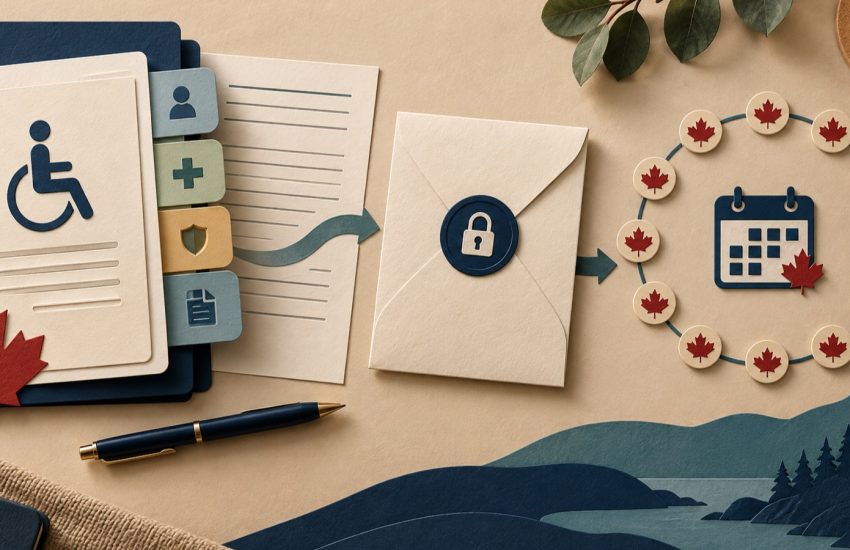
The Canada Disability Benefit is not approved from a diagnosis name alone. The federal decision joins age, Disability Tax Credit status, tax residency, immigration or legal status, and filed tax returns. The payment calculation then adds family income, marital status and working income.
This guide is a claim control room: each record has its own owner, date and repair route.
Open the five eligibility locks
You generally need to be 18 to 64. An application may be filed up to six months before the 18th birthday, but it is not processed until age 18.
You must be approved for the federal Disability Tax Credit. A provincial disability decision is not a substitute.
You must be a Canadian resident for income-tax purposes. This is a tax-status test, not just a mailing-address check.
You must fit one of the legal-status categories on the federal eligibility page, including the specific rule for temporary residents.
You and a spouse or common-law partner, if applicable, must have filed the required federal return for the benefit period.
Read these as gates, not as a points system. Strong evidence for four does not compensate for a missing fifth. The current federal page says the July 2026 to June 2027 payment period uses the 2025 federal income tax return. If a spouse or common-law partner is part of the household, their filing can also be required.
The eligible legal-status categories listed by Canada include Canadian citizen, permanent resident, a person registered or entitled to be registered under the Indian Act, protected person, and a temporary resident who has lived in Canada throughout the previous 18 months. Definitions and exceptions can matter. Use the current federal wording for your situation rather than a social-media checklist.
A person serving a sentence of two years or more in a federal penitentiary is generally not eligible except for the first and last month of incarceration. The official page says a person who becomes ineligible for that reason must reapply after release.
The DTC is a dependency, not the benefit itself
The Disability Tax Credit is a tax measure administered by the Canada Revenue Agency. The Canada Disability Benefit is an income-tested payment administered through Service Canada. CDB eligibility depends on an approved DTC, but approval for the DTC does not by itself guarantee a positive CDB payment. Age, residence, status, returns and income still matter.
If a DTC application is underway, record the submission date and which medical practitioner completed the certification. Do not file a CDB application on the assumption that DTC approval is automatic. If the DTC was approved for a period that has ended, check the certificate’s effective dates and any renewal request. If CRA has not connected the DTC to the correct individual, resolve that record before expecting the CDB process to work cleanly.
As of September 2026, the federal government has also implemented a $150 CDB supplemental payment intended to help offset the cost of obtaining the DTC. Canada says it is paid as a lump sum, does not require a separate application and can apply for each approved DTC certificate that entitles the person to a monthly CDB payment. The timing depends on when the person first received CDB. This supplement is not the same as the regular monthly allocation.
Use the correct benefit year
Benefit timing often becomes confusing because three calendars overlap: the tax year that supplies income, the July-to-June payment period, and the month an application is approved. A change in 2026 income does not necessarily alter a payment calculated from the 2025 return during the same month. It may affect a later annual calculation. A marital-status or residency change can have a different reporting rule and should be reported promptly.
Canada says payment starts the month after an application is approved. The first payment is normally sent on the third Thursday of that month and can include eligible back payments. Back payments may reach up to 24 months from the date Service Canada receives the application, but cannot cover months before the program’s earliest eligibility month in June 2025.
How the amount is built
For July 2026 through June 2027: the maximum is $204.20 per month. The amount is based on adjusted family net income from the 2025 return. Up to $10,210 of working income is exempt for a single person, or up to $14,294 of combined working income for a person with a spouse or common-law partner.
The working-income exemption is not the same as an eligibility ceiling. It removes a specified amount of employment, self-employment or taxable scholarship income before the reduction calculation. Income above the exemption does not automatically create a zero benefit. The result also depends on marital status, adjusted family net income and whether both partners receive the CDB.
Adjusted family net income begins with line 23600 from the applicant’s return and, when applicable, the spouse’s or common-law partner’s return. Federal instructions make adjustments for Universal Child Care Benefit and Registered Disability Savings Plan amounts received or repaid. Use the official estimator with the notices of assessment in front of you. The estimator is a planning tool, not an approval decision.
If the total annual allocation is $240 or less—equivalent to $20 or less per month—Canada says it is generally issued as one lump sum for the remaining months of the payment period. A small lump sum is therefore not necessarily a missing monthly schedule.
Build an evidence wallet before applying
Identity and status pocket
- Social Insurance Number;
- mailing address and reliable contact details;
- legal status information required by the application;
- unique six-digit application code, if Service Canada sent one;
- direct-deposit details, if you choose that method.
Tax and benefit pocket
- 2025 notices of assessment for both partners where applicable;
- line 23600 amounts;
- working-income records used for an estimate;
- DTC approval dates and correspondence;
- marital-status effective date and current address.
You do not upload every item merely because it is in the wallet. The purpose is to prevent contradictory entries and help you answer the application accurately. Provide only what the official process requests. Keep sensitive identifiers out of ordinary email, chat or unofficial forms.
Choose one official application entrance
Service Canada offers online, telephone, in-person and paper application methods. If you received an invitation letter, its six-digit code can simplify the process. If you did not receive a letter, you can still apply; the federal page lists the information required without a code.
For an online application, confirm that the address begins on Canada.ca and leads to the official Service Canada process. Save the submission confirmation. For a telephone application, record the date and the official number used, but never write down an agent’s personal identifiers. For an in-person application, use the Service Canada office locator. For paper, download the current form and use the address printed on the current federal application page.
A trusted person can help an applicant, but helping is not automatically the same as being a legal representative. When a representative applies on someone’s behalf, the application asks for representative information and supporting authority. Follow the official representative route instead of sharing an applicant’s code or sign-in credentials informally.
The application state machine
Submitted
Save proof of the date Service Canada received the application. That date can affect back-payment calculations.
Identity or record check
Service Canada may compare the application with DTC, tax, status and household records. Respond through the stated official channel if information is requested.
Decision
The notice should say whether you qualify, the payment amount and effective period. Read the reasons and dates, not just the result.
First payment
An approved applicant is generally paid the month after approval, on the third Thursday, with eligible back payments included.
Annual review
The program reassesses information for each July-to-June cycle. Continue filing required tax returns and report changes.
Do not send a duplicate application simply because the first payment has not arrived. Check whether a decision was issued, whether direct deposit or mailing information is correct, and whether the first scheduled Thursday has passed. If Service Canada requests information, note the response deadline and keep proof of delivery.
When a payment changes or stops
Canada lists several possible reasons: missing responses to Service Canada, contact or bank changes, marital-status changes, family-income changes, a lost eligibility condition, or certain incarceration. A payment may also be redirected under a family-support enforcement process. The program should send a letter explaining a change.
Match the repair to the record owner. CRA manages tax-return and DTC information. Service Canada manages the CDB application and payment file. Immigration or status documents may come from another authority. Updating a bank account in one system may not update every benefit. Ask which organization owns the field that is wrong.
If the problem is a missing tax return, file or correct it through the CRA route. If the DTC expired, use the DTC process. If Service Canada used the wrong marital status, report the effective date and ask what evidence is required. If a cheque went to an old address, update both Service Canada and CRA where required.
Reconsideration and appeal
A denial or amount decision should come with reasons and review rights. The CDB regulations provide for reconsideration and further appeal. Read the notice for the deadline, address and form that apply to your decision. Do not rely on a deadline quoted in an old forum post.
Build the review request around the decision reason. Identify the disputed finding, state the correct fact, attach the relevant official record and explain how it changes the result. More pages are not automatically stronger evidence. A dated DTC approval, notice of assessment or status document tied to the reason is usually more useful than a general personal narrative.
Keep a copy of the request and proof that it was received. If the deadline is close, contact Service Canada or a qualified community legal clinic promptly. FADC does not provide legal representation and cannot determine whether an appeal will succeed.
Coordinate the CDB with other supports
The CDB can interact with provincial disability assistance, housing subsidies, private disability coverage and other income-tested programs. The federal payment is non-taxable, but another program may have its own treatment of the amount. Do not assume it is ignored everywhere because it is not reported as taxable income.
Ask each program a specific question: “How is the Canada Disability Benefit treated for eligibility, benefit calculation and reporting?” Record the policy source and date. If a worker gives an answer that affects a large amount or ongoing entitlement, request the written policy or decision notice.
The CDB is also different from CPP disability, provincial disability income and the DTC. Each uses a different test. A person can meet one test and not another. Keep the acronyms in separate folders so a medical form, tax certificate and income-support decision do not become one confusing file.
Build a private support roadmap around the CDB
The Canada Disability Benefit may be one layer of a larger support plan. Use FADC’s private check to surface other reviewed programs worth verifying, then confirm every rule on the official program page.
Questions people ask at the control room
Do I qualify because I receive provincial disability assistance?
Not automatically. CDB eligibility has its own federal gates, including DTC approval, age, tax residence, legal status and filed returns.
Is the maximum $204.20 guaranteed?
No. It is the maximum monthly amount for July 2026 through June 2027 before income-based reduction. The actual result can be lower or zero.
Do I need the Service Canada invitation letter?
No. The official application page provides a route for people who did not receive a letter. A code can simplify an application but is not the eligibility test.
Is the $150 supplement a monthly increase?
No. The federal government describes it as a lump-sum supplemental payment related to the cost of obtaining an approved DTC certificate. It does not require a separate application.
Will CDB appear on my tax return?
Canada states that CDB payments are non-taxable and no tax slip is issued, although annual tax filing remains an eligibility requirement.
The most reliable CDB application is not the longest. It is the one in which the DTC, tax year, family record, status and Service Canada application all describe the same person and period. Use the claim control room to find the broken link, repair it with the correct organization and preserve the receipt.
Editorial note: This article provides general program navigation, not legal, tax or financial advice. Amounts, dates and rules can change. Verify your situation on Canada.ca or with Service Canada.
Sources officielles
Ressources officielles du gouvernement et du système de santé
Consultez les sources officielles pour vérifier les critères d’admissibilité en vigueur, les horaires, les règles d’inscription et la disponibilité des services cliniques.
- Santé Canada
- Fédération des organismes de réglementation médicale du Canada
- Tous les liens vers les provinces et les territoires
- 811, guide d’orientation pour les soins d’urgence et l’hospitalisation
Avertissement médical : Find a Doctor Canada fournit des renseignements pour s’y retrouver dans le système de santé, mais ne donne ni diagnostic ni conseil médical personnalisé. En cas d’urgence, composez le 911.


