

Endocrinologist Near Me: Referrals, Tests & Next Steps
Réponse rapide
Find an endocrinologist in Canada, understand referral routes, build a triage-ready packet, track the wait and know when routine care is not enough.
- Commencez par la voie d’inscription officielle ou par la voie de rattachement.
- Vérifiez directement les critères d’admissibilité locaux, la zone de desserte et les places disponibles actuellement.
- Conservez un registre daté et prenez les mesures de soins provisoires appropriées en attendant.
Publié le : September 21, 2026 Dernière mise à jour : September 21, 2026
“Hormone problem” is not yet a referral destination
Endocrinology covers many systems—diabetes, thyroid, pituitary, adrenal, calcium and bone, reproductive hormones and growth—but clinics often divide those systems into different programs. The fastest safe route begins by naming the clinical question, not by sending the same request to every endocrinologist.
Use five evidence lenses before choosing a name
What result, symptom pattern or management problem needs another level of expertise?
Is the destination adult, paediatric, reproductive, diabetes-focused or a specific gland program?
Which clinician can assess first and send the referral required by the service?
Which history, laboratory results, imaging and prior treatments allow safe triage?
Who confirms receipt, manages care during the wait and acts on new information?
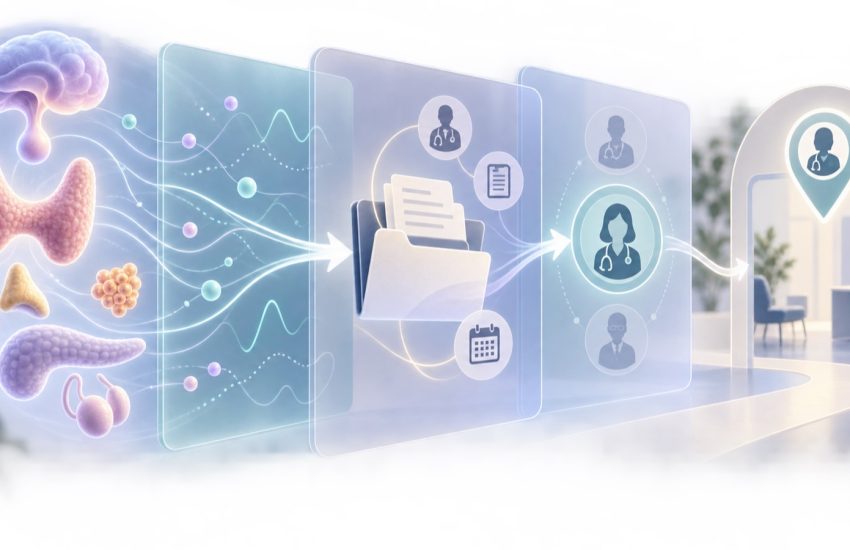
Think of the five lenses as an evidence prism: the clinical signal, service scope, gateway, packet and follow-up loop must align before a directory name becomes a defensible destination. This prevents a common failure—finding an endocrinologist whose office does not handle the question, then waiting for a referral to be declined or redirected. It also makes the FADC directory useful for what it can do—identify relevant specialty records by geography—without turning a listing into a booking promise.
What an endocrinologist does
Endocrinologists are physicians with additional training in the endocrine system: glands and hormones that influence metabolism, growth, reproduction, stress responses, calcium balance and other functions. They assess and manage selected endocrine disorders, often in partnership with primary care, diabetes educators, dietitians, pharmacists, surgeons, reproductive specialists or other physicians.
Not every abnormal result requires specialist care. A primary-care clinician or nurse practitioner may be able to repeat a test, review medication and illness effects, begin standard treatment or use an eConsult before referring. A diabetes education program may provide practical support without an endocrinologist visit. Conversely, a complex or high-risk question may need a specialized clinic even when the person already has a general endocrinologist.
Ask “What decision do we need help with?” Examples include clarifying a persistent biochemical abnormality, managing a condition that remains outside target despite appropriate care, assessing a suspected pituitary or adrenal problem, reviewing complex medication effects, or coordinating a high-risk transition. The referral should describe the decision, not simply write “hormones.”
Match the problem to the destination
The route matrix is not a self-diagnosis tool. Symptoms can overlap many conditions, and isolated laboratory values can be affected by timing, medication, pregnancy, acute illness and the test method. Let a qualified clinician interpret the pattern and decide which route is appropriate.
Do you need a referral?
Most publicly funded endocrinology consultations in Canada require a referral from an authorized clinician. The exact referrer and process vary by province, territory, health authority and service. Some programs accept referrals from physicians and nurse practitioners; some have narrower rules. A private service may use a different model, but coverage and scope must be confirmed.
Ontario Health includes endocrinology among the specialties with a standardized eReferral form. Alberta’s Referral Directory gives service-specific instructions; one endocrinology clinic, for example, directs clinicians using Connect Care to send an ambulatory referral order and tells other referrers to fax a referral form or letter with relevant investigations and initial management. A BC Children’s Hospital endocrinology program listed by HealthLink BC requires a physician referral and limits eligibility to children and youth.
These examples show why “Do I need a referral in Canada?” has no single office-independent answer. Confirm the named service’s current rule. A directory entry identifies the office; the official clinic or health-authority page establishes the gateway.
Where to start without a family doctor
A person without a regular primary-care clinician still needs an assessment gateway. Depending on location and the issue, that may be a nurse practitioner, walk-in clinic, community health centre, hospital-affiliated clinic or another authorized referrer. Bring prior results and explain that the goal is both assessment and, if appropriate, a complete referral.
Ask whether the clinician can receive and act on the specialist’s response. A one-time referral without a follow-up owner can leave medication changes, repeat testing and urgent instructions uncoordinated. If the walk-in clinic sends the referral, record its name, address, phone, clinician, submission date and how results will return.
Do not assume an emergency department will create a routine endocrinology pathway for a stable long-term issue. Emergency care is for urgent assessment and stabilization. A discharge plan may direct follow-up, but the routine referral still needs an accountable source.
Build a triage-ready referral packet
The clinical question
- the specific finding or management problem;
- when it began and how it is changing;
- relevant symptoms and functional impact;
- why specialist input is needed now.
The evidence
- dated laboratory reports and reference ranges;
- relevant imaging reports;
- medication and supplement list;
- previous treatment, response and adverse effects.
The handoff
- referrer’s contact information;
- patient’s current telephone and address;
- urgency facts, not an unsupported label;
- who will manage care while waiting.
Completeness is not the same as volume. Sending every laboratory result from ten years can hide the relevant trend. A useful packet highlights the values, dates and context that answer the service’s triage questions. Include the original reports where requested so the specialist can see reference ranges and methods.
Medication details matter because hormone tests and symptoms can be influenced by prescriptions, over-the-counter products and supplements. Include dose, schedule and recent changes. Do not stop a medication or supplement solely to make a test “cleaner” unless a clinician gives instructions.
If the clinic publishes a referral form, use the current version. Missing mandatory fields can trigger a return. The Ontario standardized form initiative is designed to improve consistency; it does not replace the receiving clinic’s scope or urgency criteria.
Track the handoff without losing the care plan
Record the exact clinic or central service, date, method and referrer. “Endocrinology somewhere” is not trackable.
Ask when acknowledgement is normally issued. Alberta’s example clinic describes referral receipt communication to the referrer within seven days, but every service has its own timeline.
Find out whether the referral was accepted, redirected, returned for information or placed on a waitlist. Ask which office owns the next contact.
Confirm date, location, appointment format, preparation instructions and cancellation process.
After the visit, confirm who receives recommendations, who orders follow-up tests and who renews medications.
Begin follow-up with the referring office. Ask whether the referral was actually transmitted and whether the receiving service acknowledged it. If the office says it was returned, ask for the reason. Common operational causes include wrong program, missing results, incomplete demographics or an out-of-date form. Fixing the stated defect is more useful than sending a duplicate.
When contacting the specialist office, keep the question administrative: Was the referral received? Has it been triaged? Is anything missing? Do not ask reception staff to change clinical priority. Report significant health changes to a clinician who can reassess and update the referral.
What to do during the wait
The referring clinician remains important. Continue agreed treatment, monitoring and safety planning. Complete requested testing, but do not order extra tests independently because you assume the specialist will want them. Ask who reviews each result and how you will be contacted if action is needed.
Keep a short change log: new symptoms, severe episodes, medication changes, emergency visits and major new results. Share meaningful changes with the clinician managing the referral. A new fact may alter the care plan or triage, but a growing diary alone does not automatically increase urgency.
If travel is involved, ask whether the first consultation can be virtual, where tests can be completed, how often in-person follow-up is typical and whether the clinic serves people outside its immediate region. A shorter listed wait can become a poor fit when repeated travel, inaccessible facilities or fragmented laboratory access are considered.
Prepare for the first visit
Bring the timeline
List the key dates: first abnormal result, repeat tests, treatment starts, dose changes and major events. Keep it to one readable page.
Bring the actual data
Carry a current medication list and copies or portal access for relevant reports. Note where images were performed if only the report is available.
Bring the decision
Write the main question: diagnosis clarification, treatment choice, procedure planning, pregnancy planning, technology support or another defined goal.
Expect the endocrinologist to revisit the history and examine the pattern rather than treating one number in isolation. They may recommend more targeted testing, continue primary-care management, change medication, involve another specialty or discharge care back to the referrer with a plan. A specialist visit is not proof that every symptom has an endocrine cause.
Useful questions include: What is the working explanation? Which findings support it? What alternatives still need consideration? Which tests are necessary, and who will review them? What should change before the next visit? Which symptoms require urgent reassessment? Who renews medications and completes forms? When does care return to primary care?
Compare endocrinology destinations honestly
Search results and physician profiles can help compare geography and stated specialty. They rarely reveal the whole service. Confirm adult versus paediatric scope, conditions seen, referral source, catchment, language, accessibility, appointment format and whether the physician is taking new referrals.
A hospital clinic may have multidisciplinary support and narrow criteria. A community specialist may handle a broader set of referrals but not every complex program. A diabetes centre may emphasize education and technology. A reproductive or metabolic bone clinic may be the better endpoint for a specific question. “Endocrinology” is the starting category, not the final proof of fit.
Do not send simultaneous referrals to several offices without coordination. Duplicates can fragment information and create confusion. If you want to change destinations, ask the referrer how to close or redirect the earlier referral and whether the new service accepts transfers.
Search Canadian endocrinology records
Use the specialty-filtered FADC route to identify possible destinations by province or city. Then confirm the clinic’s scope, referral rule and intake on an official source. A listing does not authorize self-referral or guarantee an appointment.
Connect the referral to the rest of the journey
If you need a clinician to start the process, use the FADC Find a Doctor directory and confirm that the provider can assess and refer. The walk-in specialist-referral guide explains what to track when you do not have a family doctor. If imaging or laboratory requisitions are part of the plan, use the imaging requisition guide et blood-test requisition guide without assuming every test is appropriate for every endocrine question.
A strong endocrinology route has one clinical question, one suitable destination, one complete packet and one accountable follow-up loop. That structure matters more than the length of the specialist list.
Editorial note: This article provides general navigation information, not diagnosis, triage or treatment advice. Referral rules and clinic scope vary. Confirm current requirements with the service and your provincial health system.
Sources officielles
Ressources officielles du gouvernement et du système de santé
Consultez les sources officielles pour vérifier les critères d’admissibilité en vigueur, les horaires, les règles d’inscription et la disponibilité des services cliniques.
- Santé Canada
- Fédération des organismes de réglementation médicale du Canada
- Tous les liens vers les provinces et les territoires
- 811, guide d’orientation pour les soins d’urgence et l’hospitalisation
Avertissement médical : Find a Doctor Canada fournit des renseignements pour s’y retrouver dans le système de santé, mais ne donne ni diagnostic ni conseil médical personnalisé. En cas d’urgence, composez le 911.


